
Medical weight management, with the thresholds that apply to Indian bodies rather than the ones printed on a Western chart. The scale is the least useful measurement in the room, and it is usually the only one anybody has taken.
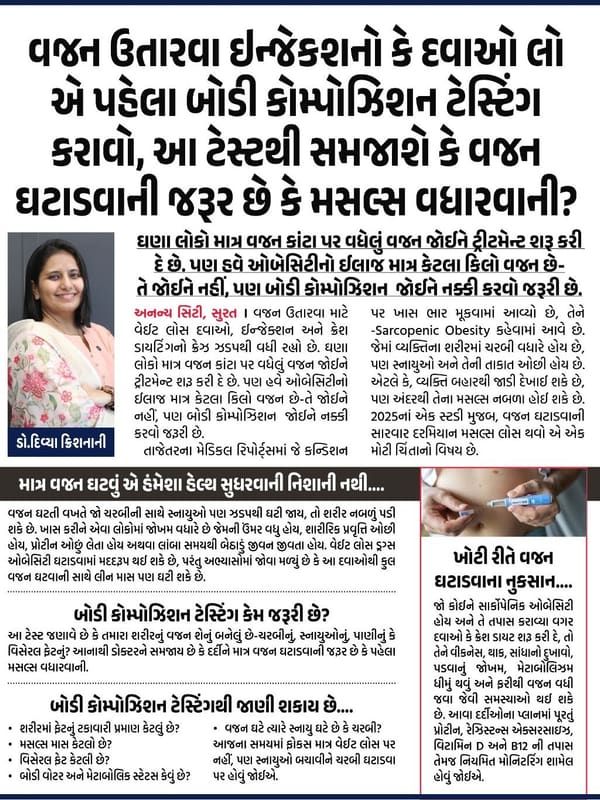
Body composition — fat mass, lean mass, visceral fat, body water — plus waist circumference. Two people at the same weight can have completely different amounts of muscle, and the treatment for each is the opposite of the treatment for the other.
Thyroid disease, insulin resistance, PCOS, cortisol excess, vitamin D and B12 deficiency, and the medications that quietly cause weight gain. Weight is a symptom before it is a diagnosis.
Adequate protein, resistance training and a calorie deficit that is survivable. Rapid loss that takes lean mass with it leaves you weaker, with a slower metabolism and a near-certain regain.
GLP-1 and related drugs work, and they are not for everyone. Prescribed on the evidence, with the muscle-loss risk monitored rather than ignored, and with a plan for what happens when they stop.
Fat, muscle, visceral fat and water, measured rather than estimated from height and weight.
Thyroid, fasting insulin and glucose, HbA1c, lipids, liver function, vitamin D and B12.
Built on Gujarati food and your actual routine. A plan you abandon in three weeks is not a plan.
Including resistance work, which is the part that decides whether the weight you lose is fat or muscle.
Where the indication is real: dose titration, side-effect management and monitoring for lean-mass loss.
Composition and waist, repeated over time. The scale alone cannot tell you whether it is working.
Most online BMI calculators use international cut-offs. Indians develop diabetes and heart disease at lower body weights, so the Indian consensus sets the lines several points earlier. This uses those.
BMI cannot tell muscle from fat, which is why a muscular person can read as overweight and a sedentary person with a normal BMI can carry a risky amount of visceral fat. Body composition testing at the clinic measures what this can only estimate.
Because the same BMI means something different in an Indian body. At any given BMI, South Asians carry more body fat and more of it around the organs than Europeans, and develop diabetes and heart disease at lower weights. The Indian consensus therefore sets overweight at a BMI of 23 and obesity at 25, against the international 25 and 30. Used on Indian patients, the international chart tells a great many people that nothing is wrong when something is.
Because where the fat sits matters more than how much there is. Fat around the organs — visceral fat — is metabolically active and drives insulin resistance, fatty liver and cardiovascular risk in a way that fat on the hips and thighs does not. A normal BMI with a large waist is a genuinely risky combination, and it is invisible to the scale.
They do, and meaningfully. They also carry side effects, cost, and a specific risk that is often glossed over: a share of the weight lost is lean muscle. That is why body composition testing before starting is worth the trouble, and why protein and resistance training are part of the prescription rather than optional extras. They are also not a course you finish — weight generally returns when they stop, so the plan has to address that from the start.
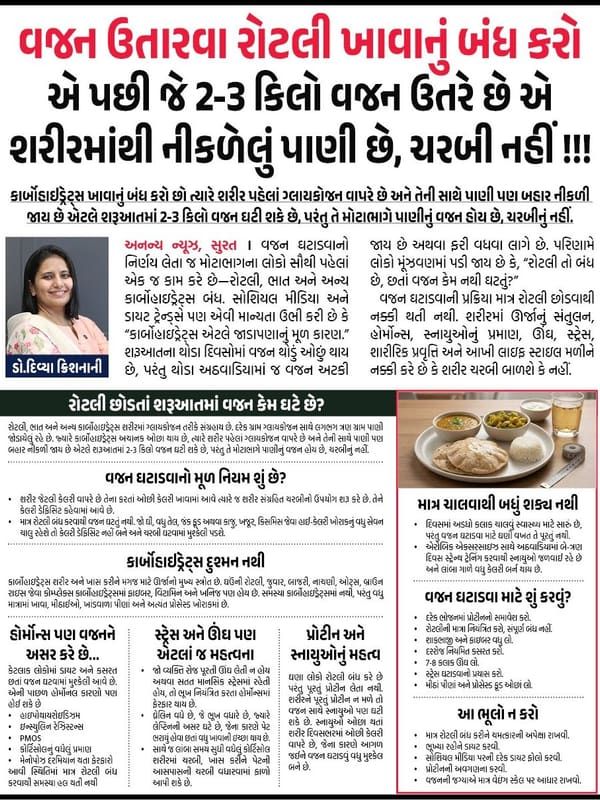
Mostly it is water. Every gram of stored carbohydrate holds roughly three grams of water with it, so cutting carbohydrate empties that store and the scale drops fast in the first fortnight. It is not fat, and it comes straight back. Dr. Divya has written a column on this because it is the single most common thing that convinces people a diet is working when it is not.
Yes, and plans that require you not to eat the food your household cooks tend to fail within a month. The work is in proportion, sequence and combination — what goes on the thali with the rice, what you eat first, how much oil the sabzi carries. That is a solvable problem. Rebuilding your entire diet around unfamiliar food usually is not.
Around half to one percent of body weight a week is the range where fat is being lost and muscle is being kept. Faster than that and you are usually losing lean tissue, which makes the weight easier to regain afterwards. Slower and more durable beats faster and temporary, in every study that has followed people beyond a year.
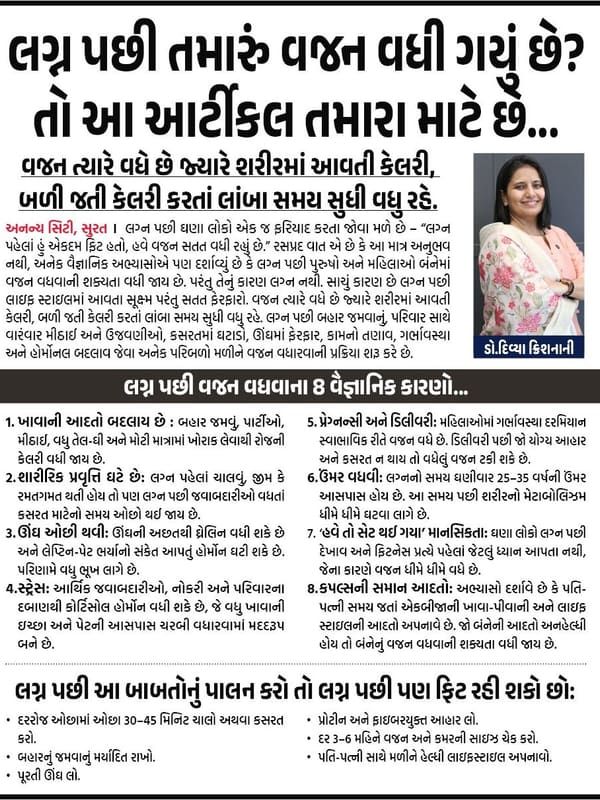
Published features from her standing column in the Surat Gujarati press.

Further reading: Diabetes-Friendly Diet
No online booking to wrestle with — the clinic answers the phone 9 AM - 9 PM, and WhatsApp is read the same day.
Not an emergency service. For a medical emergency, go to the nearest hospital.
Conditions treated
Care and diagnostics