Diabetes, thyroid, lipid, kidney and liver panels drawn and processed at the clinic. The difference that matters is not the test — any lab runs these — it is that the results are read by the doctor treating you, in the same visit, against what you came in with.
A test is only useful if its result would change something. The panel is chosen from your symptoms and history rather than ordered as a package, which is also how you avoid paying for tests nobody will act on.
Taken at the clinic. Some tests need fasting and some do not; you will be told which before you come rather than turned away on the day.
What each number means for you specifically, which ones are borderline and irrelevant, and which ones matter. A result at the edge of a reference range is not automatically a disease.
Start, change, stop or re-test. Every panel ends with a plan, because a report without a decision attached is just paper.
HbA1c, fasting and post-prandial glucose. The average and the swings.
TSH, free T3, free T4 and TPO antibodies where the cause matters.
Total, LDL, HDL and triglycerides — the cardiovascular half of metabolic risk.
Creatinine, urea, urine albumin and liver enzymes. Fatty liver and early kidney change both hide here.
Insulin, androgens, prolactin and cortisol where PCOS or another endocrine cause is in question.
Both are widely deficient in India, both cause vague symptoms, and both are easily corrected.
Most people leave a lab with a page of numbers and no idea which of them matter. Pick a test.
Measures what proportion of your haemoglobin has glucose stuck to it, which reflects the average blood glucose over roughly the last eight to twelve weeks. It is the single most useful number in diabetes because it cannot be improved by behaving yourself for two days before the test. It can read falsely low in anaemia and falsely high in iron deficiency, so it is interpreted alongside a blood count rather than alone.
A snapshot rather than an average, and it catches what HbA1c hides. Two people with the same HbA1c can have completely different days — one steady, one swinging between 60 and 300 — and it is the swings that cause symptoms and damage. Fasting glucose shows what your liver is doing overnight; the two-hour reading shows how you handle a meal.
Total cholesterol, LDL, HDL and triglycerides. In diabetes the characteristic pattern is high triglycerides and low HDL rather than dramatically high total cholesterol, which is why a "normal cholesterol" result can be quietly reassuring about the wrong thing. Triglycerides are strongly affected by what you ate the night before, which is why fasting matters here.
TSH is the pituitary's instruction to the thyroid, and it moves first — which is why it is the screening test. A raised TSH with a normal free T4 means the gland is being pushed harder to keep output normal. Free T3 matters mainly where an overactive thyroid is suspected. TPO antibodies say whether the cause is autoimmune, which changes the outlook and matters a great deal in pregnancy.
Creatinine and eGFR for the kidneys, plus urine albumin — which turns abnormal years before creatinine does and is the earliest sign diabetes is affecting them. Liver enzymes pick up fatty liver, which affects most people with type 2 diabetes and has no symptoms until it is advanced. Neither organ complains early, so both are monitored rather than waited on.
Both are common enough in India to be worth checking rather than guessing at, and both cause exactly the vague symptoms — fatigue, aches, low mood, pins and needles — that get attributed to something else for years. B12 deficiency is more likely on long-term metformin and in vegetarian diets, which between them cover a large share of this clinic's patients.
A number just outside a reference range is not automatically a disease — ranges are population statistics, and healthy people fall outside them. The pattern across tests and the trend over time matter more than any single value.
Fasting glucose and the lipid profile genuinely do — typically eight to twelve hours, water allowed. HbA1c, thyroid tests, kidney and liver function and vitamin levels do not. Fasting unnecessarily for tests that do not need it is common, uncomfortable, and occasionally dangerous if you are on insulin.
Every three months while treatment is being adjusted, because HbA1c reflects roughly the previous eight to twelve weeks and testing sooner shows you nothing new. Every six months once you are stable and at target.
Usually not on its own. Reference ranges are population statistics, so a proportion of entirely healthy people fall just outside them, and a single marginal value in isolation rarely means anything. What matters is the pattern across tests, the trend across time, and whether you have symptoms. That is precisely what gets lost when a report is read without a consultation.
Please do. Previous results are how a trend becomes visible, and a trend is worth far more than any single reading. Bring everything you have, including the old ones you assume are irrelevant.
Because the samples are processed at the centre rather than sent out. In practice that means the consultation and the results happen in one visit instead of two, which matters most when something needs to change today.
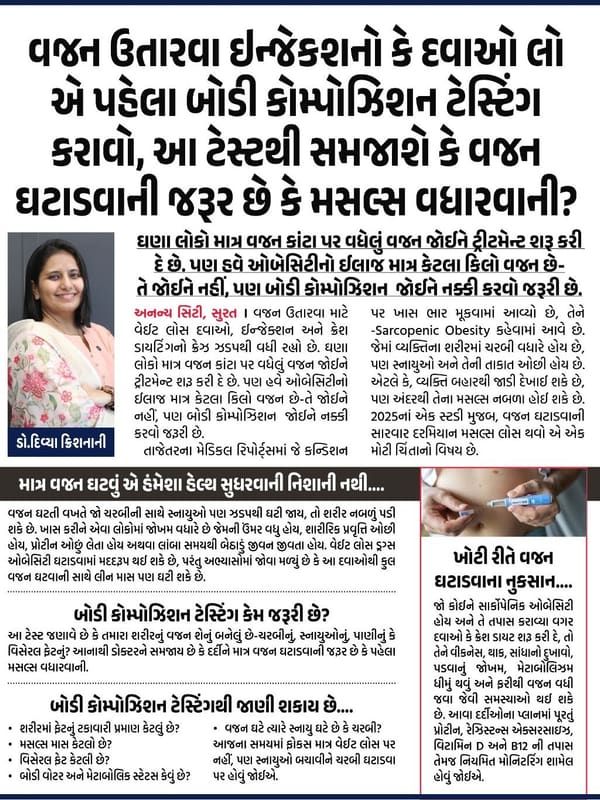
Published features from her standing column in the Surat Gujarati press.
No online booking to wrestle with — the clinic answers the phone 9 AM - 9 PM, and WhatsApp is read the same day.
Not an emergency service. For a medical emergency, go to the nearest hospital.
Conditions treated
Care and diagnostics